Tata Products List PDF
Download Tata Products List PDFfor free by clicking the direct download hyperlink provided at the bottom of this article.
The Tata Group is an immense multinational conglomerate located in India that has many subsidiary and joint venture companies. Tata Sons Limited is the holding company of the Tata Group and holds the major shareholdingin the companies. Tata Sons Ltd is the owner of the Tata name and the Tata trademarks, which are registered in India and other countries.
Subsidiary companies belonging to the Tata Group and Joint Ventures that have 'TATA' in their names are:
Tata AIG -- an insurance-based Joint Venture company together with AIG.Tata AutoComp Systems, India's leading automotive components conglomerate
Tata Capital -- a wholly owned subsidiary of Tata Sons Limited, the holding company belonging to the Tata Group
Tata Chemicals
Tata CLiQ -- eCommerce website that sells clothing shoes, electronics, and other items.
Tata Communications -- a communications company
Tata Consultancy Services (TCS)is Asia's leading IT company and the largest service and software company.
Tata Consulting Engineers Ltd.
Tata Defence
Tata Elxsi --Product Design & Technology company
Tata Global Beverages, the second-largest tea business in the world.
Tetley -- subsidiary of Tata Global Beverages
Tata Housing Development Company, Real estate development company
Tata Value Homes Limited -100% Subsidiary of Tata Housing, operating in the value and affordable segments.
Tata Motors -- India's largest, and the world's fifth largest automobile company.
Tata Motors' principal subsidiaries include:
Tata Motors Cars -- produces passenger cars with the Tata Motors marque
Jaguar Land Rover -- British company that makes Jaguar and Land Rover vehicles
Fiat-Tata, a joint partnership with Fiat that manufactured Fiat and Tata brand vehicles, as well as automotive parts.
Tata Daewoo
Tata Hispano -- coach builder
Tata Hitachi Construction Machinery
Tata Marcopolo
Tata Technologies - Engineering, Product Lifecycle Management, Information Technology, Automotive, Aerospace, Construction and Heavy Machinery, Manufacturing and Digital Manufacturing
Tata Power -- India's largest electricity producer in the private sector.
Tata Power Solar
Tata Projects - Engineering, Procurement& Construction
Tata Salt- a subsidiary of Tata Chemicals
Tata Sky -- a Direct To Home service company in partnership with British Sky Broadcasting and Newscorporations STAR
Tata Starbucks- a joint venture of Tata Global Beverages and Starbucks(US).
Tata Steel, World's 12th largest steel company
Tata Steel Europe, formerly Corus group
Tata Steel BSL, a steel company formally called Bhushan steel limited
Tata Bearings
Tata Sponge Iron Ltd.
Tata Metaliks Ltd.
Tata Teleservices Ltd., Telecommunications, Tata Tele Business Services
Tata Group history is also an account of the historyof Indian industry
A history of a huge corporation is also the history of Indian industry
It is the history of a huge corporation which is also an important part of the history of Indian industry By Rachna TyagiOctober 14 October 14, 2018 at 15:29. 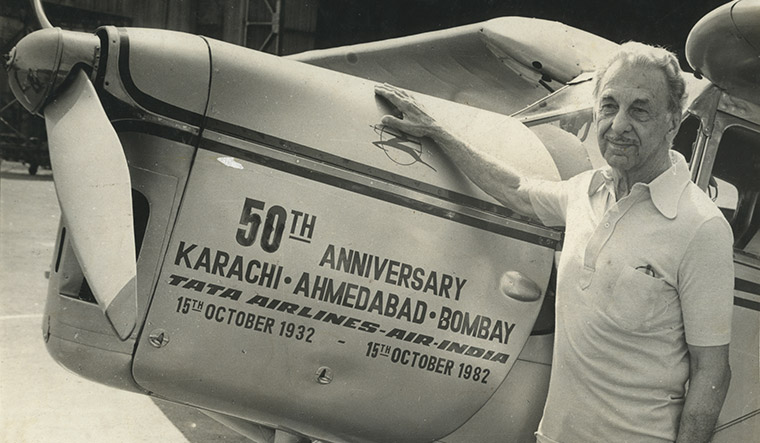 The Aviator: J.R.D. Tata at the 50th anniversary of the 1932 Karachi-Ahmedabad-Bombay flight.
T.R. Doongaji originates from Nagpur which is the city where Jamsetji Nusserwanji Tata started his first venture, Empress Mills, in 1877. When he was around 6 years of age, Doongaji's cousin would take him to the temple where, before entering the building, he'd ask for him to put his head to a statue which was "the founder" placed on the pedestal. "I did what he asked me to," declares Doongaji. "Today, I realise that my entire identity is this name." A J.N. Tata researcher, the scholar worked for 52 years (42 in executive capacity) with Tata Group and was a managing director of three Group companies.Jamsetji established a provident plan for his employees, which was the first of its kind in India, and an insurance fund.Ratan Tata spearheaded the group's global pursuits. Not just the huge-ticket purchases however, but also a thoughtful expansion that leveraged the strengths of the group.
In the past some political leaders in Nagpur wanted to rename the convocation hall of Nagpur University, the J.N. Tata Hall, to a local leader's name. One of the friends from Nagpur called Doongaji and asked if he knew about it. Doongaji dug through the Tata Central Archives to see what the hall's history was before it got the name. "We discovered there was evidence that Empress Mills Nagpur had contributed towards the cost of the hall and we have all the information. We won the case in the High Court. I will not allow anybody to take Tata's name or property," Says Parsi, who is proud of his victory. Parsi.
A few businesses can boast this kind of loyalty from its people. In addition, Doongaji attributes it to the management in the Tata Group. Tata Group. "Between the founder and Cyrus [Mistry], there have been four chairmen--three were knighted and one is a Bharat Ratna," Says Doongaji. "How many groups are able to claim that kind of leadership?
The story began when Jamsetji bought a ten-acre parcel of marshy land from the Nagpur king and set up Empress Mills. (It was registered at Bombay in 1874, as Central India Spinning, Weaving and Manufacturing Company Limited. Jamsetji had established an trading company in 1868.)
Jamsetji did not want his employees to work in the squalid conditions that he had seen in Lancastershire's textile mills. Thus, when he was at Empress Mills, he ensured adequate ventilation, and also had an apparatus for humidifying air. Sprinklers were put in place to minimize the destruction caused that could be caused by accidental fires. He also created an insurance scheme for provident funds, one of the very first in India as well as an accident compensation fund.
When Jamsetji was back in Bombay the following year, he was able to earn enough money to pay his attention to purchasing property. He soon became one of the most wealthy men in the country. He started investing in the industrial future of India and developed plans for numerous ambitious projects.The first family members: (Standing on the to the left) Jamsetji Tata's younger son Ratan, Jamsetji and Ratan's wife; (sitting from left) Jamsetji's wife Hirabai, Dorabji's partner Meherbai And Dorabji.
During a visit to the US at the request from industrialist George Westinghouse, Jamsetji saw the hydroelectric scheme at Niagara Falls. Jamsetji had planned a hydroelectric project in India and the trip to America firmed it up. Within the Lonavala and Khandala areas in the Western Ghats, which gets one of the largest rainfalls worldwide and is blessed with the perfect combination of soil, valleys and slopes, he started his work of the Tata Hydroelectric Supply Company. The massive pipes carried water up Khopoli, the highest mountain in Khopoli which, when it reached the power house it was transformed into electrical energy. The project proved to be an event-changing one, as it supplied electricity to the city that was growing in Bombay.
Tata Hydroelectric Supply Company was declared a public concern on November 7 in 1910. The company started the project on February 11, 1915 when Lord Willingdon Governor of Bombay established the project. "Today, the major chunk of our power is being supplied to industries, hospitals and residences," says Rajesh G. Naik, the head of operations and maintenance, Tata Power. The total capacity of the plant is 447mw.
A big attraction at The project's 14 acres garden located in Lonavala. Jamsetji was an avid enthusiast in gardening, and brought home plants and seeds from across the globe. When the steel plant at Jamshedpur was in the process of being built and he wrote a lengthy letter to his son, Dorabji, on the fast-growing number of trees he wanted to grow on his property. Said Vivek Vishwasrao, head of biodiversity at Tata Power: "We fall in the northern region of the Western Ghats which is a significant bio-diversity hotspot. Certain species of animals, plants and birds found in this region aren't found elsewhere in the world." Similar to the beautiful Tata Baug, built in 1891 and spread over 22 acres within Navsari, is maintained by Dr. Rohinton Avari, who holds a doctoral degree in landscape horticulture.
Jamsetji used to be known as an "omnivorous reader", and was a lover of Dickens and Thackeray. "He was fond of driving, a keen judge of horseflesh, and duly happy with his birthright Arabs, English Hackneys or Hungarians as well as his professional turnout. There were times when he loved boating and sailing, as well as entertaining friends at picnic parties," writes Frank Harris in his book Jamsetji Nusserwanji Tata: A Story of His Personal Life.
In the realm of 'firsts jehangir Ratanji Dadabhoy Tata's achievements stand out. From getting India's first pilot's license, to creating the first cancer hospital in the nation, J.R.D. Tata set the stage for the development of India. Tata's father R.D. Tata was a cousin of Jamsetji's mother and her mother was Suzanne Briere, a French citizen. Tata was born in Paris and spent his youth in France. After his father's death, his son succeeded him as director at Tata Sons at the age of 22.
J.R.D. became Tata Sons chairman in 1938 at the age 34 years old. The group had 14 companies then. When he left in 1991 and was replaced by 95. However, his contributions extended far further than Tata Group and its businesses. For instance, he helped Homi Bhabha establish India's nuclear energy program. Then he helped Homi Bhabha's son Jamshed Bhabha to establish the National Centre for Performing Arts (NCPA) in Mumbai.Matter of loyalty: T.R. Doongaji | Janak Bhat
The brightest star of the companies J.R.D. founded included Tata Airlines (which later became Air India), as it quickly earned a world-wide reputation as being among the top carriers. "J.R.D. would always state"that Air India was his first love I'd like to think to hear him affirm"that Tata Steel was his second," says J.J. Irani, the former manager of Tata Steel. "He would laugh at that, but he never gave me an answer."
Read more about it here. Tata Products List PDF
Comments
Post a Comment